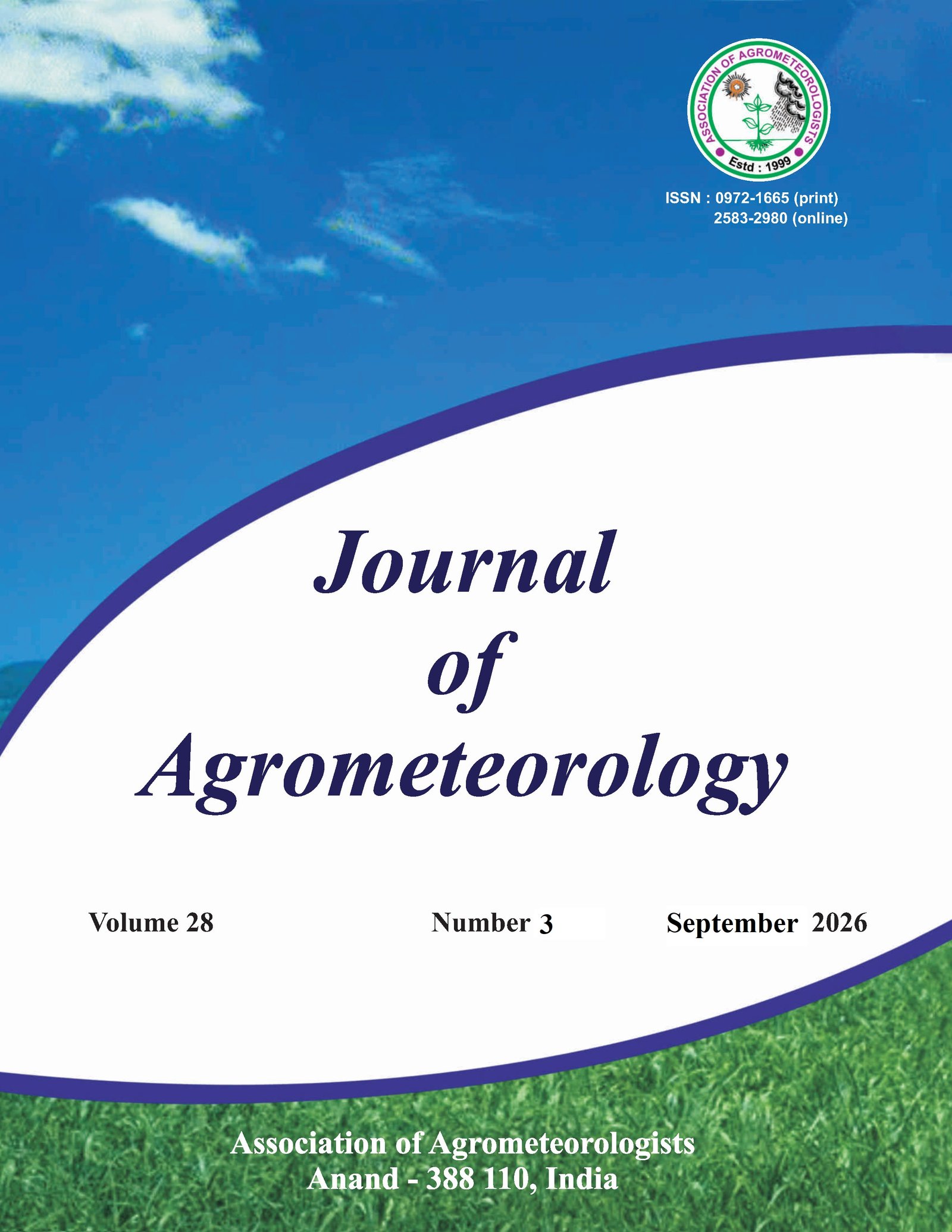
Application of MCDM Techniques in Ranking of CMIP6 GCMs for Extreme Temperatures over the Periyar River Basin
DOI:
https://doi.org/10.54386/jam.v28i3.3405Keywords:
Extreme Temperatures, Periyar River Basin, Ranking, TOPSIS, Compromise Programming, GDMAAbstract
Climatic extremes like temperature extremes are susceptible to climate change (CLC) warming impacts. Thus, it is essential to study the effect of CLC on extreme temperatures (minimum temperature, i.e., Tmin and maximum temperature, i.e., Tmax) of the Periyar River Basin (PRB), which has several human-induced constraints. Choosing the best general circulation models (GCMs) from a set through ranking is needed for precise projections of future climatic variables. None of the reviewed studies has executed GCMs ranking for 6th phase of Coupled Model Intercomparison Project (CMIP6) corresponding to extreme temperatures of the PRB. Thus, in the current study, ranking of 27 CMIP6 GCMs is performed for extreme temperatures at every grid point of the PRB by using four performance indicators, entropy method and Compromise Programming (CP) and Technique for Order Preference by Similarity to an Ideal Solution (TOPSIS). The aggregated ranking of GCMs corresponding to the whole study area for extreme temperatures is also executed by employing the Group Decision-Making Approach (GDMA). Top six ranked GCMs obtained through GDMA for Tmax are FGOALS-g3, BCC-CSM2-MR, CanESM5, GFDL-CM4-gr2, GISS-E2-1- G and CNRM-CM6-1 corresponding to TOPSIS and CP techniques while that for Tmin are KIOST-ESM, CanESM5, CNRM-CM6-1, INM-CM5-0, INM-CM4-8 and GISS-E2-1-G.
References
Ahmed, K., Sachindra, D. A., Shahid, S., Demirel, M. C., & Chung, E. S. (2019). Selection of multi-model ensemble of general circulation models for the simulation of precipitation and maximum and minimum temperature based on spatial assessment metrics. Hydrology and Earth System Sciences, 23(11), 4803–4824. https://doi.org/10.5194/hess-23-4803-2019
Gebisa, B. T., Dibaba, W. T., & Kabeta, A. (2023). Evaluation of historical CMIP6 model simulations and future climate change projections in the Baro River Basin. Journal of Water and Climate Change, 14(8), 2680–2705. https://doi.org/10.2166/wcc.2023.032
Harris, I., Osborn, T. J., Jones, P., & Lister, D. (2020). Version 4 of the CRU TS monthly high- resolution gridded multivariate climate dataset. Scientific Data, 7(1), 109. https://doi.org/10.1038/s41597-020-0453-3
Hassan, I., Kalin, R. M., White, C. J., & Aladejana, J. A. (2020). Selection of CMIP5 GCM ensemble for the projection of spatio-temporal changes in precipitation and temperature over the Niger Delta, Nigeria. Water, 12(2), 385. https://doi.org/10.3390/w12020385
Jia, K., Ruan, Y., Yang, Y., & You, Z. (2019). Assessment of CMIP5 GCM simulation performance for temperature projection in the Tibetan Plateau. Earth and Space Science, 6(12), 2362–2378. https://doi.org/10.1029/2019EA000962
Jose, D. M., & Dwarakish, G. S. (2022). Ranking of downscaled CMIP5 and CMIP6 GCMs at a basin scale: Case study of a tropical river basin on the southwest coast of India. Arabian Journal of Geosciences, 15(1), 120. https://doi.org/10.1007/s12517-021-09289-0
Khan, N., Shahid, S., Ahmed, K., Ismail, T., Nawaz, N., & Son, M. (2018). Performance assessment of general circulation model in simulating daily precipitation and temperature using multiple gridded datasets. Water, 10(12), 1793. https://doi.org/10.3390/w10121793
Lei, Y., Peng, P., & Jiang, W. (2023). Evaluation of global climate models for the simulation of precipitation and maximum and minimum temperatures at coarser and finer resolutions based on temporal and spatial assessment metrics in mainland China. Journal of Water and Climate Change, 14(5), 1585–1599. https://doi.org/10.2166/wcc.2023.464
Lebeza, T. M., Gashaw, T., Bayabil, H. K., Van Oel, P. R., Worqlul, A. W., Dile, Y. T., & Chukalla, A. D. (2024). Performance of specific CMIP6 GCMs for simulating the historical rainfall and temperature climatology of Lake Tana sub-basin, Ethiopia. Scientific African, 26, e02387. https://doi.org/10.1016/j.sciaf.2024.e02387
Loganathan, P., & Mahindrakar, A. B. (2020). Assessment and ranking of CMIP5 GCMs performance based on observed statistics over Cauvery River basin–Peninsular India. Arabian Journal of Geosciences, 13, 1–11. https://doi.org/10.1007/s12517-020-06217-6
Pradhan, P., Shrestha, S., Sundaram, S. M., & Virdis, S. G. (2021). Evaluation of CMIP5 general circulation models for simulating the precipitation and temperature of the Koshi River Basin in Nepal. Journal of Water and Climate Change, 12(7), 3282–3296. https://doi.org/10.2166/wcc.2021.124
Sadhwani, K., & Eldho, T. I. (2023). Assessing the vulnerability of water balance to climate change at river basin scale in humid tropics: Implications for a sustainable water future. Sustainability, 15(11), 9135. https://doi.org/10.3390/su15119135
Sadhwani, K., Eldho, T. I., & Karmakar, S. (2023). Investigating the influence of future land use and climate change on hydrological regime of a humid tropical river basin. Environmental Earth Sciences, 82(9), 210. https://doi.org/10.1007/s12665-023-10891-6
Salehie, O., Hamed, M. M., Ismail, T. B., Tam, T. H., & Shahid, S. (2023). Selection of CMIP6 GCM with projection of climate over the Amu Darya River Basin. Theoretical and Applied Climatology, 151(3–4), 1185–1203. https://doi.org/10.1007/s00704-022-04332-w
Salman, S. A., Shahid, S., Ismail, T., Ahmed, K., & Wang, X. J. (2018). Selection of climate models for projection of spatiotemporal changes in temperature of Iraq with uncertainties. Atmospheric Research, 213, 509–522. https://doi.org/10.1016/j.atmosres.2018.07.008
Seker, M., & Gumus, V. (2022). Projection of temperature and precipitation in the Mediterranean region through multi-model ensemble from CMIP6. Atmospheric Research, 280, 106440. https://doi.org/10.1016/j.atmosres.2022.106440
Shiru, M. S., & Chung, E. S. (2021). Performance evaluation of CMIP6 global climate models for selecting models for climate projection over Nigeria. Theoretical and Applied Climatology, 146(1–2), 599–615. https://doi.org/10.1007/s00704-021-03746-2
Sreelatha, K., & AnandRaj, P. (2020). Regional evaluation of global climate models for precipitation, maximum and minimum temperature over southern-part of India. ISH Journal of Hydraulic Engineering, 28(sup1), 449–462. https://doi.org/10.1080/09715010.2020.1779137
Srinivasa Raju, K., & Nagesh Kumar, D. (2015). Ranking general circulation models for India using TOPSIS. Journal of Water and Climate Change, 6(2), 288–299. https://doi.org/10.2166/wcc.2014.074
Srinivasa Raju, K., Sonali, P., & Nagesh Kumar, D. (2017). Ranking of CMIP5-based global climate models for India using compromise programming. Theoretical and Applied Climatology, 128, 563–574. https://doi.org/10.1007/s00704-015-1721-6
Sun, Q., Miao, C., & Duan, Q. (2015). Comparative analysis of CMIP3 and CMIP5 global climate models for simulating the daily mean, maximum, and minimum temperatures and daily precipitation over China. Journal of Geophysical Research: Atmospheres, 120(10), 4806– 4824. https://doi.org/10.1002/2014JD022994
Venkatesh, J., & Kale, G. D. (2025). Ranking of CMIP6 GCMs and formulation of multi-model ensembles for precipitation projection under SSP245 and SSP585 scenarios over the Ujjani Dam catchment in India by using machine learning and conventional methods. Environmental Science Pollution Research, 32, 20574–20599. https://doi.org/10.1007/s11356-025-36853-y.
Zamani, R., & Berndtsson, R. (2019). Evaluation of CMIP5 models for west and southwest Iran using TOPSIS-based method. Theoretical and Applied Climatology, 137, 533–543. https://doi.org/10.1007/s00704-018-2616-0
Zhang, Y., You, Q., Ullah, S., Chen, C., Shen, L., & Liu, Z. (2023). Substantial increase in abrupt shifts between drought and flood events in China based on observations and model simulations. Science of the Total Environment, 876, 162822. https://doi.org/10.1016/j.scitotenv.2023.162822
Downloads
Published
How to Cite
License
Copyright (c) 2026 MARK ARNOLD BULSARI, GANESH D. KALE, VENKATESH JARPALA

This work is licensed under a Creative Commons Attribution-NonCommercial-ShareAlike 4.0 International License.
This is a human-readable summary of (and not a substitute for) the license. Disclaimer.
You are free to:
Share — copy and redistribute the material in any medium or format
Adapt — remix, transform, and build upon the material
The licensor cannot revoke these freedoms as long as you follow the license terms.
Under the following terms:
Attribution — You must give appropriate credit, provide a link to the license, and indicate if changes were made. You may do so in any reasonable manner, but not in any way that suggests the licensor endorses you or your use.
NonCommercial — You may not use the material for commercial purposes.
ShareAlike — If you remix, transform, or build upon the material, you must distribute your contributions under the same license as the original.
No additional restrictions — You may not apply legal terms or technological measures that legally restrict others from doing anything the license permits.
Notices:
You do not have to comply with the license for elements of the material in the public domain or where your use is permitted by an applicable exception or limitation.
No warranties are given. The license may not give you all of the permissions necessary for your intended use. For example, other rights such as publicity, privacy, or moral rights may limit how you use the material.