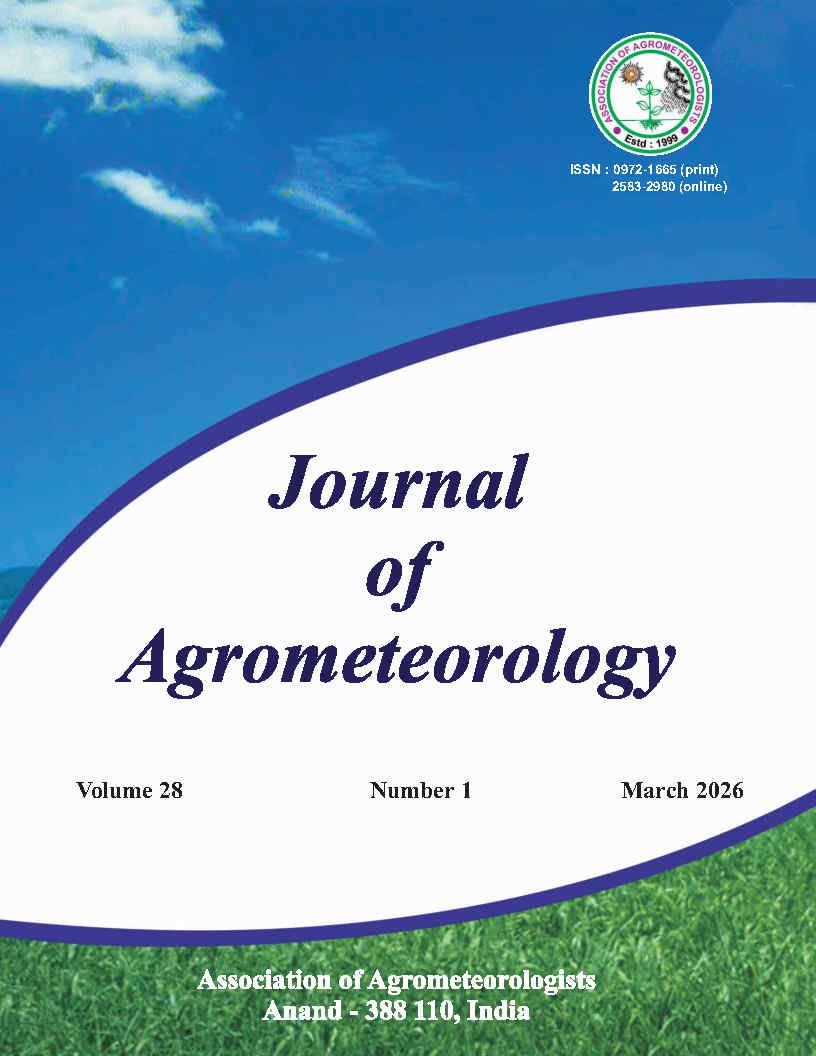
Climatological Understanding of Heat and Cold Wave Variability in Eastern Uttar Pradesh
DOI:
https://doi.org/10.54386/jam.v28i1.3217Keywords:
Heat Wave, Cold Wave, Eastern Uttar Pradesh, MD gridded data, Excess heat factor (EHF), Kernel Density Estimation (KDE)Abstract
This study examines the trends and impacts of heat waves (HWs) and cold waves (CWs) in Eastern Uttar Pradesh, India, from 1961 to 2020, utilizing gridded daily maximum and minimum temperature data from the Indian Meteorological Department. This study analyzes the decadal totals of days, maximum continuous duration days, and mean maximum and minimum temperatures of HWs and CWs across nine meteorological stations. The findings reveal a significant increase in HW occurrences, particularly in stations like Fatehpur and Varanasi, while a decline in CW events is noted across the region. The Excess Heat Factor (EHF) index indicates a rising trend in heat stress events, and this study suggests that the intensity of HWs is increasing due to changes in temperature variability rather than mean warming alone.
References
Bhatla, R., Pant, M., Singh, D., Verma, S., & Mandal, B. (2020a). Evaluation of cold wave events over Indo-Gangetic Plain in India. Journal of Agrometeorology, 22(2), 233-238. https://doi.org/10.54386/jam.v22i2.178
Bhatla, R., Varma, P., Verma, S., & Ghosh, S. (2020b). El Nino/La Nina impact on crop production over different agro-climatic zones of Indo-Gangetic Plain of India: Theoretical and Applied Climatology, 142(1), 151-163. https://doi.org/10.1007/s00704-020-03284-3
Bhattacharya, A., Thomas, A., Soni, V. K., Roy, P. S., Sarangi, C., & Kanawade, V. P. (2023). Opposite trends in heat waves and cold waves over India. Journal of Earth System Science, 132(2), 67. https://doi.org/10.1007/s12040-023-02069-2
Bouwer, L. M. (2018). Observed and projected impacts from extreme weather events: implications for loss and damage. In Loss and damage from climate change: Concepts, methods and policy options (pp. 63-82). Cham: Springer International Publishing. https://doi.org/10.1007/978-3-319-72026-5_3
Chand, R., & Ray, K. (2014). Analysis of extreme high temperature conditions over Uttar Pradesh, India. In High-Impact Weather Events over the SAARC Region (pp. 383-397). Cham: Springer International Publishing. https://doi.org/10.1007/978-3-319-10217-7_26
Dash, S. K., & Mamgain, A. (2011). Changes in the frequency of different categories of temperature extremes in India. Journal of Applied Meteorology and Climatology, 50(9), 1842-1858. https://doi.org/10.1175/2011JAMC2687.1
Gawai, A. S., Pal, R. K., & Singh, S. (2024). Assessment of heat and cold wave incidences and their link with land surface temperature in Bathinda district of Punjab, India. Journal of Agrometeorology, 26(2),204-208. https://doi.org/10.54386/jam.v26i2.2398
IPCC (2014) Summary for policymakers In: Climate Change 2014: Impacts, Adaptation, and Vulnerability. Part A: Global and Sectoral Aspects. Contribution of Working Group II to the Fifth Assessment Report of the Intergovernmental Panel on Climate Change (Cambridge Cambridge, United Kingdom and New York, NY, USA) ed C B Field et al. (Cambridge University Press) pp 1–32
Mahdi, S. S., Dhekale, B. S., Choudhury, S. R., Haque, M., & Gupta, S. K. (2020). Magnitude, frequency, trends of heat and cold waves in recent decades and impact assessment in wheat: the case of north Bihar, India. Journal of Agrometeorology, 22(4). https://doi.org/10.54386/jam.v22i4.457
Mohamed, M. A. E. H., Hwehy, M. M., Moursy, F. I., & El-Tantawi, A. M. (2023). The synergy of ambient air quality and thermal discomfort: A case study of Greater Cairo, Egypt. Journal of Agrometeorology, 25(4), 553-559. https://doi.org/10.54386/jam.v25i4.2309
Narkhede, N., Chattopadhyay, R., Lekshmi, S., Guhathakurta, P., Kumar, N., & Mohapatra, M. (2022). An empirical model-based framework for operational monitoring and prediction of heatwaves based on temperature data. Modeling Earth Systems and Environment, 8(4), 5665-5682. https://doi.org/10.1007/s40808-022-01450-2
Rajeevan, M., Rohini. P, Smitha Anil Nair, Snehalata Tirkey, Tanmoy Goswami, Naresh Kumar (2023). Heat and Cold Waves in India- Processes and Predictability. Meteorological Monograph, MoES/IMD/Synoptic Met/01(2023)/28. https://mausam.imd.gov.in/responsive/met2.php
Ratnam, J. V., Behera, S. K., Annamalai, H., Ratna, S. B., Rajeevan, M., & Yamagata, T. (2016). ENSO’s far reaching connection to Indian cold waves. Scientific Reports, 6(1), 37657. https://doi.org/10.1038/srep37657
Ray, K., Giri, R. K., Ray, S. S., Dimri, A. P., & Rajeevan, M. (2021). An assessment of long-term changes in mortalities due to extreme weather events in India: A study of 50 years’ data, 1970–2019. Weather and Climate Extremes, 32, 100315. https://doi.org/10.1016/j.wace.2021.100315
Rohini, P., Rajeevan, M., & Srivastava, A. K. (2016). On the variability and increasing trends of heat waves over India. Scientific Reports, 6(1), 1-9. https://doi.org/10.1038/srep26153
Shi, L., Kloog, I., Zanobetti, A., Liu, P., & Schwartz, J. D. (2015). Impacts of temperature and its variability on mortality in New England. Nature Climate Change, 5(11), 988-991. https://doi.org/10.1038/nclimate2704
Singh, S., Mall, R. K., & Gautam, P. K. (2025). Spatio-Temporal Changes in Cold Wave Characteristics Over the Diverse Meteorological Sub-Divisions of India. Pure and Applied Geophysics, 182(2), 859-875. https://doi.org/10.1007/s00024-024-03647-1
Downloads
Published
How to Cite
Issue
Section
Categories
License
Copyright (c) 2025 RAJEEV BHATLA, HARI SHANKAR PATEL, RICHA SINGH, RISHABH SHARMA, B. MANDAL

This work is licensed under a Creative Commons Attribution-NonCommercial-ShareAlike 4.0 International License.
This is a human-readable summary of (and not a substitute for) the license. Disclaimer.
You are free to:
Share — copy and redistribute the material in any medium or format
Adapt — remix, transform, and build upon the material
The licensor cannot revoke these freedoms as long as you follow the license terms.
Under the following terms:
Attribution — You must give appropriate credit, provide a link to the license, and indicate if changes were made. You may do so in any reasonable manner, but not in any way that suggests the licensor endorses you or your use.
NonCommercial — You may not use the material for commercial purposes.
ShareAlike — If you remix, transform, or build upon the material, you must distribute your contributions under the same license as the original.
No additional restrictions — You may not apply legal terms or technological measures that legally restrict others from doing anything the license permits.
Notices:
You do not have to comply with the license for elements of the material in the public domain or where your use is permitted by an applicable exception or limitation.
No warranties are given. The license may not give you all of the permissions necessary for your intended use. For example, other rights such as publicity, privacy, or moral rights may limit how you use the material.