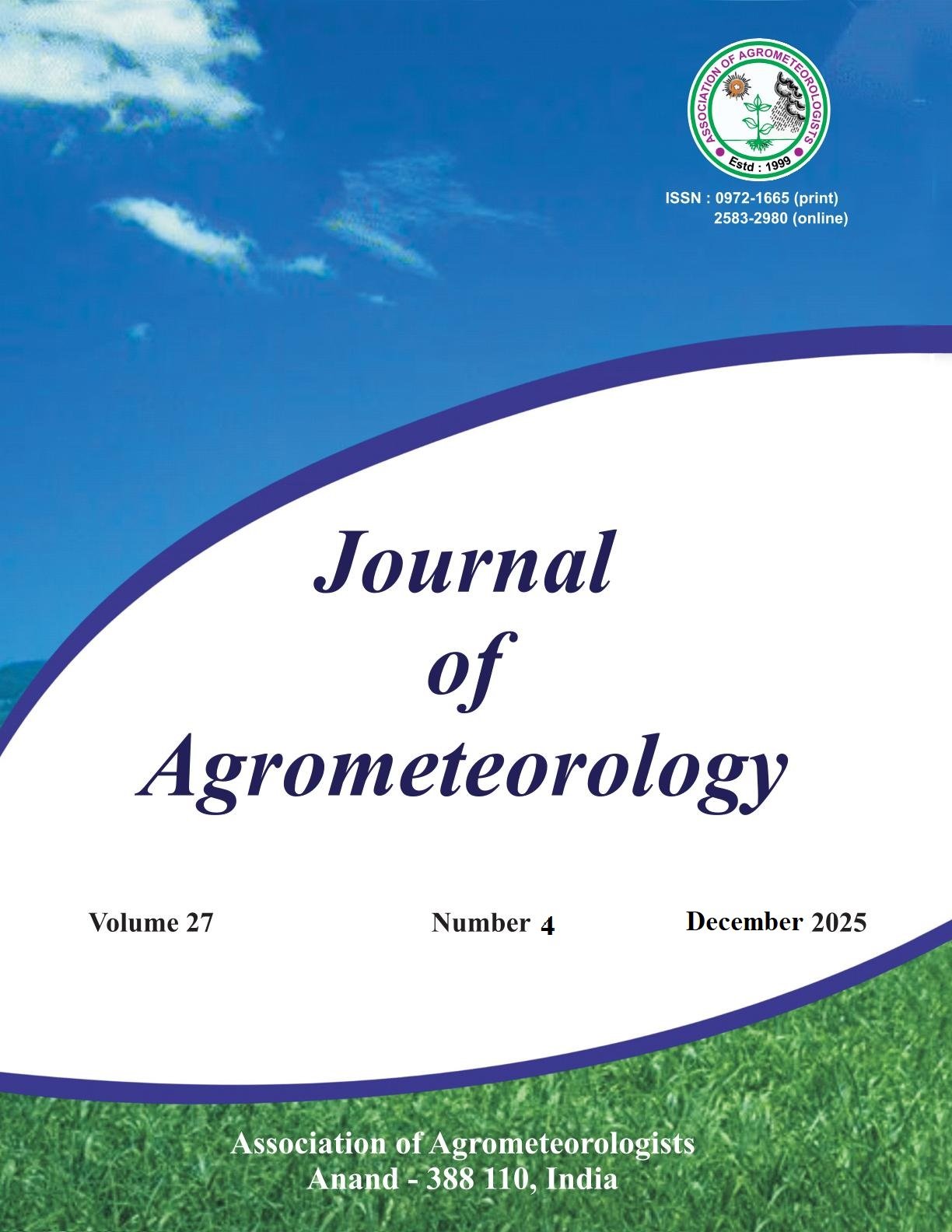
Effect of climate variability on rubber production in Thailand
DOI:
https://doi.org/10.54386/jam.v27i4.3096Keywords:
Rubber production, Rainfall variability, feasible generalized least squares (FGLS), Cobb-Douglas production functionReferences
Chaiyaphet, B.K., Pakoktom, R. and Tiwa, T. (2015). The relationship between meteorological factors and yield of para rubber tree (Hevea brasiliensis). Paper presented at the 12th KU-KPS Conference, Kasetsart University, Kamphaeng Saen Campus, Nakhon Pathom, Thailand.
Dell, M., Jones, B.F. and Olken, B.A. (2014). What do we learn from the weather? The new climate-economy literature. J. Econ. Lit., 52(3): 740–798. https://doi.org/10.1257/jel.52.3.740
Germanwatch. (2021). Global climate risk index (CRI). Germanwatch. Retrieved from https://www.germanwatch.org/en/cri
Limsakul, A. and Paengkaew, W. (2014). Relationship between climate variables and rubber production in the coastal areas of the Gulf of Thailand and the Andaman Sea. J. Thai Environ. Eng., 28(2–3): 67–77.
Makkaew, K.R.K. and Sdoodee, S. (2015). The impact of rainfall fluctuation on days and rubber productivity in Songkhla Province. J. Agric. Technol., 11(1): 181–191.
Mesike, C. and Esekhade, T. (2014). Rainfall variability and rubber production in Nigeria. Afr. J. Environ. Sci. Technol., 8(1): 54–57. https://doi.org/10.5897/AJEST2013.1593
Prasada, I.Y., Dhamira, A. and Nugroho, A.D. (2021). Effects of climatic factors on the productivity of smallholder rubber plantations in South Sumatra, Indonesia. Reg. Sci. Inquiry, 13(2): 109–121.
Raj, S. and Dey, S.K. (2004). Spatial analysis of rainfall variability over the northeast with respect to rubber cultivation. J. Agrometeorol., 6 (Special Issue): 52–57.
Sangchanda, N., Ayutthaya, S.I.N., Meetha, S. and Songsri, P. (2014). The influence of rainfall on growth of rubber trees in marginal area of Northeast Thailand. Adv. Mater. Res., 844: 7–10. https://doi.org/10.4028/www.scientific.net/AMR.844.7
Sdoodee, S. and Rongsawat, S. (2012). Impact of climate change on smallholders’ rubber production in Songkhla Province, southern Thailand. Paper presented at the International and National Conference for the Sustainable Community Development of “Local Community: The Foundation of Development in the ASEAN Economic Community (AEC)”, Nakhon Pathom, Thailand.
Sdoodee, S. (2013). The use of double-tapping systems to increase latex yield and reduce dry bark in rubber trees in northeastern Thailand [Research report]. Bangkok, Thailand: Thailand Research Fund Office.
Sdoodee, S. and Somboonsuke, B. (2015). The impact of global warming on rubber production in Songkhla Province (Phase II): Case study of rubber smallholders’ adaptation [Research report]. Bangkok, Thailand: Thailand Research Fund.
Shao-jun, L., Jin-he, T., Jing-hong, Z., Xiao-min, C. and Wei-guang, L. (2020). Study on potential productivity of rubber model based on climate data. Chin. J. Agrometeorol., 41(2): 113–120. https://doi.org/10.3969/j.issn.1000-6362.2020.02.006
Stock, J.H. and Watson, M.W. (2020). Introduction to Econometrics. Pearson. pp. 800.
Thai Meteorological Department. (2021). Daily temperature and precipitation statistics. Bangkok, Thailand: Ministry of Digital Economy and Society.
Thai Office of Agricultural Economics. (2022). Monthly rubber planting area and production data. Bangkok, Thailand: Ministry of Agriculture and Cooperatives.
Thaiburi, N., Sinnarong, N., Autchariyapanitkul, K. and Nunthasen, K. (2021). Impacts of climate change on rubber production in lower southern Thailand. Princess Naradhiwas Univ. J., 13(2): 372–385.
Thaiburi, N. (2022). Impacts of climate change on rubber production in lower southern Thailand. Doctoral dissertation, Maejo University, Chiang Mai, Thailand.
Trinh, T.A. (2018). The impact of climate change on agriculture: Findings from households in Vietnam. Environ. Resour. Econ., 71(4): 897–921. https://doi.org/10.1007/s10640-017-0189-5
Downloads
Published
How to Cite
Issue
Section
Categories
License
Copyright (c) 2025 SIRIKLAO SANGKHAPHAN, PAT PATTANARANGSUN, SOMSKAOW BEJRANONDA

This work is licensed under a Creative Commons Attribution-NonCommercial-ShareAlike 4.0 International License.
This is a human-readable summary of (and not a substitute for) the license. Disclaimer.
You are free to:
Share — copy and redistribute the material in any medium or format
Adapt — remix, transform, and build upon the material
The licensor cannot revoke these freedoms as long as you follow the license terms.
Under the following terms:
Attribution — You must give appropriate credit, provide a link to the license, and indicate if changes were made. You may do so in any reasonable manner, but not in any way that suggests the licensor endorses you or your use.
NonCommercial — You may not use the material for commercial purposes.
ShareAlike — If you remix, transform, or build upon the material, you must distribute your contributions under the same license as the original.
No additional restrictions — You may not apply legal terms or technological measures that legally restrict others from doing anything the license permits.
Notices:
You do not have to comply with the license for elements of the material in the public domain or where your use is permitted by an applicable exception or limitation.
No warranties are given. The license may not give you all of the permissions necessary for your intended use. For example, other rights such as publicity, privacy, or moral rights may limit how you use the material.